Pages

S/SW blog philosophy -

I credit favorite writers and public opinion makers.

A lifelong Democrat, my comments on Congress, the judiciary and the presidency are regular features.

My observations and commentary are on people and events in politics that affect the USA or the rest of the world, and stand for the interests of peace, security and justice.


Showing posts with label National security. Show all posts

Wednesday, March 18, 2015

The Future of our Nation Examined Through the Eyes of Twitter

Do you ever worry about the future of our nation?
Re-reading my Twitter/HootSuite 2015 national news threads just now, proved to be alarming for me.
  1. Budget War talk started early.
  2. Republicans made head-spinning claims as soon as they took over.
  3. Legislating under Republicans began with the meaningless Keystone Pipeline bill.
  4. My own crazy state of Texas has not disappointed in its heartlessness this year.
  5. The Secret Service admitted to having problems with alcohol.
The Republican budget that has just been introduced favors the "One Percent."  It would abandon large swaths of vulnerable people.  Even though they claim credit for an improving economy, Congress will do nothing to fix the essential infrastructure needed to support and continue that healthy economy.  The Keystone Pipeline benefits the Canadian economy.  Texas turns farther towards the extreme right as each month passes.  And we cannot protect the safety of the POTUS.  These realities reinforce my worry about what is happening to the USA in early 2015 .

But there are bright spots that should not be ignored.
Not all Congressional Republicans are stupid or corrupt.  Science continues to prevail.  Truth continues to have its brave apologists. We can count on our centuries old friend, Europe, to have our back.  Some states in the USA are not insane.  And optimists tweet.

 
Follow me at Twitter.

Friday, February 22, 2013

On the subject of national security, reading it later* is another option.

Steven Aftergood, at the FAS Project on Government Secrecy, discussed a new judge for the FISA court.  The article also discussed the idea of setting up a similar court to “review the conduct of drone strikes.”

Spencer Ackerman, writing for Wired/Danger Room, says that a cash strapped Army still plans on helping Pakistan fight narcotics. To quote his conclusion:

It’ll be a long time before the U.S. military gets out of the south-Asian anti-drug game, whatever the budget situation might be.

Aljazeera is reporting that Egypt will hold parliamentary elections.  Details:

Voting will take place in four stages with new People's Assembly invited to convene on July 6, presidential decree says.

*Source: Get Pocket.com (formerly Read It Later) is my aggregator.

Wednesday, May 30, 2012

It just depends . . .

obamaflag

Where is the rule of law here?  “Secret ‘Kill List’ Proves a Test of Obama’s Principles and Will.”  This recent New York Times story has left more than a few people very unsettled. The headline poses the dilemma faced by the United States:  Under whose law do we wage war?  Will it be President Obama’s enforcement of the law, or the more widespread official legal system of U.S. Constitutional law – Common Law going back to the Magna Carta of 1215 AD?   It is a terribly slippery slope upon which the so-called “war on terrorism” has embarked.

Stated policy does not have the true force of law.  No matter how clearly the current executive branch system articulates the principles under which targeted drone killings occur, the President under our democratic system cannot act as prosecutor,  judge and jury.  That means either inside or outside of our national borders.  The rule of law applies everywhere.  The rules of war forbid killing of innocent civilians.  No matter how much I politically support this president, plan to vote for him in November, believe in his intellect and skill and see him as my leader, his authority is limited by the Constitution’s separation of powers.  I am not alone in this opinion.  Many civil libertarians find the current revelations about the drone war deeply troubling.

No man is above the law.   Congress represents the people and can speak for them.  The courts interpret the law.  Andrew Bacevich writes in Mother Jones about “America’s Rising Shadow Wars.”  Subtitled, “President Obama has expanded secret military operations worldwide—a policy that carries serious risks,” the author argues that,
From a president's point of view, one of the appealing things about special forces is that he can send them wherever he wants to do whatever he directs. There's no need to ask permission or to explain. Employing USSOCOM as your own private military means never having to say you're sorry . . .
Once in a while, members of Congress even cast votes to indicate approval or disapproval of some military action. With special ops, no such notification or consultation is necessary. The president and his minions have a free hand. Building on the precedents set by Obama, stupid and reckless presidents will enjoy this prerogative no less than shrewd and well-intentioned ones.

The policies of the Obama administration have evolved a great deal since Barack Obama was Illinois’ Senator Obama. Faced with the expectation that our Presidents will keep us safe as seemingly any cost, President Obama has moved a very long way from where he began in his public service.   “Drones: the Silent Killers” is from a Newsweek feature story at the Daily Beast.  It opens with excerpts from Daniel Klaidman’s new book, Kill or Capture: The War on Terror and the Soul of the Obama Presidency.  To quote:
  • The president's troubled reaction to a botched strike during his first month in office
  • His uneasy acceptance of "signature strikes" in Pakistan, or the targeting of groups of men who bear characteristics associated with terrorism, but whose identities aren’t known. Obama didn't like the idea of "kill 'em and sort it out later," says one source
  • The formation of a “special troika on targeted killings” that includes Obama, vice chairman of the Joint Chief James “Hoss” Cartwright, and counterterrorism aide John Brennan
  • Top State Dept. lawyer Harold Koh wondering, “How did I go from being a law professor to someone involved in killing?"
  • The president’s having “no qualms” about the fatal strike on American-born cleric Anwar al-Awlaki
  • Obama’s resistance—and ultimate relenting—to the use “signature strikes” on Yemen’s al Qaeda branch this spring

So when it comes to the rule of law over fighting suspected terrorists, it just depends  on to whom you listen.  We must listen to our President and his National Security Adviser, John Brennan, to Attorney General Eric Holder at the Justice Department, the Office of General Council, Tom Donilon, Chief of Staff/National Security Council, and others in the administration.  And we must also listen to defenders of liberty from the Fourth Estate, the press.

Press References: Rule of Law is my Twitter list showing tweets by a number of civil libertarians, investigative journalists and others who have influenced my thinking over the years.  They include Glenn Greenwald at Salon, the American Civil Liberties Union organization, Jeremy Scahill at The Nation Magazine, Jeff Stein at SpyTalk, Jason Leopold at TruthOut,  Marcy Wheeler at emptywheel.net, the Lawfare blog, and Democracy Now!

Friday, April 06, 2012

Subscribe to some of these great Email newsletters from “Congressional Quarterly.”

WASHINGTON, DC - JANUARY 27:  U.S. Secretary o...WASHINGTON, DC - JANUARY 27: U.S. Secretary of Homeland Security Janet Napolitano, seen through a television camera view finder, addresses the Homeland Security Policy Institute January 27, 2011 at George Washington University in Washington, DC. Napolitano announced that the color-coded Homeland Security Advisory System will be replaced by a simpler two-tier system. (Image credit: Getty Images via @daylife)

The one that I have read for several years -- 

most of the time from top to bottom -- is: CQ Behind the Lines (CQ Roll Call behindthelines-service@newsletters.cqrollcall.com)

Source: CQ Homeland Security.  Rob Margetta, CQ Homeland Security Editor; Arwen Bicknell, Behind the Lines Editor
Published by CQ Roll Call
---------------------------------
Other CQ Roll Call Products you might want to check out include:
CQ Floor Video
CQ Weekly
CQ Today
CQ Amendment Text
CQ BillTrack
CQ Budget Tracker
CQ HealthBeat
CQ Homeland Security
CQ Hot Docs
CQ House Action Reports
CQ LawTrack
CQ MoneyLine
CQ StateTrack
Roll Call
See all CQ Roll Call products

To sign up for CQ Roll Call's free newsletters, click here.
Copyright © 2012 CQ Roll Call. All rights reserved.
Enhanced by Zemanta

Sunday, November 20, 2011

The Surveillance State(s)

The cliche "big brother is watching you" is now becoming more the reality.  These stories caught my eye just in the last couple of days.


New York's finest, detectives working on gathering intelligence entered church sanctuaries and basements to surveil Occupy Wall Street protestors.  Words and phrases found on Twitter will be data mined for clues to possible uprisings and unrest.  Texas border patrol agents may soon be the recipients of night vision equipment and unmanned drones that come home from the Middle East.  And with U.S. financing, Afghanistan has plans to gather biometric data on all coming and going to or from the country, and eventually will fingerprint, photograph and scan the irises of all Afghans.  Seen together it is a not a picture that matches with our vision of assumptions about freedom, privacy or justice.  Not to mention spending inordinate amounts of public money on such ventures.


Even in Churches, Wall Street protesters can’t escape the watch of police.* (After their encampent in Zucotti Park was destroyed by the highly militarized NYC police department), protestors had been allowed to sleep in welcoming churches. The police entered the churches with the excuse of needing a bathroom.  To quote from the New York Times story, 
. . . demonstrators were sleeping on the cushioned pews of a United Methodist church on the Upper West Side on Thursday morning when one of them spotted a man in plainclothes wandering through the sanctuary, apparently counting heads.
"U.S. Spy Agency to Use Twitter to Forecast Unrest" is the headline.  According to Scientific American, a US intelligence agency aims to forecast unrest by studying . . . social media. This is the use of so-called open source intelligence and it amounts to more widespread domestic surveillance. To quote:
It is every government's dream: a system that can predict future events such as riots, political upheavals and the outbreak of wars.The Intelligence Advanced Research Projects Activity (IARPA), a research arm of the US intelligence community, is sponsoring the work under the Open Source Indicators (OSI) program. The three-year project, with an unspecified budget, is designed to gather digital data from a range of sources, from traffic webcams to television to Twitter. The goal, according to IARPA, is to provide the intelligence community with predictions of social and political events that can "beat the news".


Here is a recent tweet I posted regarding the possiblity of widespread coordination of recent police actions:
GeeCarolNov 16, 4:08pm via HootBar

A long list of possibilities for #OWS raid coordination via DHS | Fusion Center Locations/Contact Information: is.gd/wvMo1Z

Using left-over war-zone equipment along the Texas border is the idea of Rep. Ted Poe (R-TX).  More and more we see evidence that domestic security is becoming militarized.  To quote from the New York Times

The Send Equipment for National Defense Act, written by RepresentativeTed Poe, a Republican from Humble, would require that 10 percent of certain equipment returned from Iraq — like Humvees, night-vision equipment and unmanned aerial surveillance craft — be made available to state and local agencies for border-security operations.
Afghanistan has big plans for obtaining biometric data.  And the United States will pay for it.  (Note also recent news of far more widespread demand for identity cards for voting).To quote from the New York Times:

A handful of other countries fingerprint arriving foreigners, but no country has ever sought to gather biometric data on everyone who comes and goes, whatever their nationality. Nor do Afghan authorities plan to stop there: their avowed goal is to fingerprint, photograph and scan the irises of every living Afghan. It is a goal heartily endorsed by the American military, which has already gathered biometric data on two million Afghans who have been encountered by soldiers on the battlefield, or who have just applied for a job with the coalition military or its civilian contractors.The Kabul airport program is also financed by the United States, with money and training provided by the American Embassy. Americans, like all other travelers, are subject to it.


*In conclusion, for years I have blogged about civil liberties or security.  Despite the fact that "the war on terror" was always a misnomer, Fourth amendment protection from unreasonable search or seizure remains at increased risk for citizens of states becoming more and more militarized.

Tuesday, November 01, 2011

I long for peace

National security has long been a subject of my blogging.  One of my best resources has been a Homeland Security newsletter I receive, published by Congressional Quarterly.  It is called Behind the Lines.  It's wonderful author is David C. Morrison.  I quote from his most recent piece: 
The decade-long splurge on intelligence spending in the United States appears to have hit its high-water mark, with $54.6 billion expended on non-Pentagon spy agencies and programs in fiscal 2011, The Washington Post’s Greg Miller blogs.
From this information one would surmise that we are less and less secure, necessitating bigger spending.  That is not the case any more.  We are more secure, less threatened.  And we should be able to move out of this "all war on terror/all over the world" mentality.


I long for peace.


Enhanced by Zemanta

Friday, October 07, 2011

Assessing the threat of terrorism via overhead spycraft -

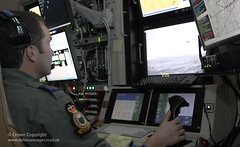
39 Squadron Reaper Pilot at Creech Air Force BaseImage by Defence Images via Flickr
Spying on adversaries from above is one way the U.S. assesses the level of danger from terrorists.  There are many times when those assigned the role of providing protection from the sky go about it in a very big way.  Here's an interesting story about a craft destined for eventual surveillance use in Afghanistan.  It is from today's Wired Danger Room and describes a giant spy blimp that dwarfs an 18-wheeler.

In stark contrast, drones are also getting smaller.  Portability, cost containment, and minimum use of personnel also seem to be attractive to the military.  The DIY-Drone of the Future Is … a Flying Pogo Stick comes again from Wired Danger Room (10/6/11).  To quote:
Darpa is holding a contest to design the military’s next spy mini-drone. So far, the entrants include a flying pogo stick, a sail that lands on mosques, and an unmanned laser shooter.

Those are some of concept videos submitted to UAV Forge, a Pentagon experiment to crowdsource the development of unmanned aerial vehicles. DIY-drone hobbyists are encouraged to work together to create the flying spy-bot of the future. It has to fit in a rucksack and be operated by just one person without any help, guidelines say.
Remotely operated combat drones are not problem free, as it turns out.  Recently it was revealed that a Computer Virus Hits U.S. Drone Fleet.  To quote from another Wired Danger Room article:
[10/7/11] A computer virus has infected the cockpits of America’s Predator and Reaper drones, logging pilots’ every keystroke as they remotely fly missions over Afghanistan and other warzones.
The virus, first detected nearly two weeks ago by the military’s Host-Based Security System, has not prevented pilots at Creech Air Force Base in Nevada from flying their missions overseas. Nor have there been any confirmed incidents of classified information being lost or sent to an outside source. But the virus has resisted multiple efforts to remove it from Creech’s computers, network security specialists say. And the infection underscores the ongoing security risks in what has become the U.S. military’s most important weapons system.
* * * * * * * * * * 
For my readers who follow the subject of national security, I am recommending "Behind the Lines" listed under Free Alerts / CQ Roll Call free newsletters.  To quote briefly from today's newsletter (always so well-done by David C. Morrison):
Holy Wars: Following last week’s CIA hit on U.S. citizens Anwar al-Awlaki and Samir Khan, “the last terrorist left chatting in an American accent is a chubby former metalhead named Adam Gadahn,” Danger Room follows up. “It is possible that Awlaki was assassinated because he was an effective critic of the U.S. government,” Paul Craig Roberts wildly reaches in HoweStreet.com. A new e-book, “The Just Scale — On the Permissibility of Killing the Infidels’ Children and Women,” published by a jihadi forum, attempts to refute mainstream arguments against killing certain types of civilians, IPT News notes. If proven to have been carried out by right-wing extremists, Sunday’s attack against a mosque in the Galilee “will be just the latest sign that Jewish terrorism is gaining steam,” The Jerusalem Post reports. A new online journalism course on Islam appears to downplay the threat posed by global jihadism, suggesting reporters keep the death toll from Islamic terrorism in “context,” FOX News relates.
Given the recent killing of the terrorist al-Awlaki and others in Yemen, predator drone warfare will continue to be the subject of debate among concerned Americans.  Stay tuned.

[Post date: 10/7/11]


My Other Blogs: Check out my Amplify blog for synopses of current news stories. My creative website is Making Good Mondays. Follow me at Twitter. And Carol Gee - Online Universe is the home page for all my websites.

Saturday, October 01, 2011

Why civil liberties should still matter -

With his family by his side, Barack Obama is s...President Obama's Inauguration.  Image via Wikipedia
South by Southwest is an old political blog I began in 2005.  For whatever reason, I focused on the subject of constitutional civil liberties almost from the beginning.*  Perhaps it was my belief that the Republican Bush administration began riding roughshod over the Bill of Rights' First and Fourth Amendments almost immediately after the 9/11/01 attacks on the United States.

Fast forward to January 2009 when the current Democratic Barack Obama administration began.
It became apparent to me over time that not that much changed under our Constitutional Law professor president. 

The U.S. recently confirmed that Anwar al-Awlaki was killed in a military drone strike.  And almost from when this news became known, there was a debate between civil libertarians and the rest of the country over the justification of the U.S. military action in northern Yemen.  In its news article today's New York Times points to the President's dilemma.  To quote,
The strike was the culmination of a desperate manhunt marked not only by near misses and dead ends, but also by a wrenching legal debate in Washington about the legality — and morality — of putting an American citizen on a list of top militants marked for death. It also represented the latest killing of a senior terrorist figure in an escalated campaign by the Obama administration.
. . . There had been an intense debate among lawyers in the months before the Obama administration decided to put Mr. Awlaki on a target list in early 2010, and officials said that Mr. Khan was never on the list. The decision to make Mr. Awlaki a priority to be sought and killed was controversial, given his American citizenship. The American Civil Liberties Union, which fought unsuccessfully in the American court system to challenge the decision to target Mr. Awlaki, condemned the killing. 
Commentators on television, the blogosphere and social media soon raised questions about the legality and morality of the "assassainations" or war combatant targeting of two United States citizens.  So I am not alone with my discomfort.  That view is not widely held beyond the members of the left. But it does give many of us pause. Michael J.W. Stickings, my longtime blog friend at The Reaction, wonders whether President Obama is "a disaster for civil liberties."  He mirrors my own ambivalence, saying:
Though I remain, for the most part, a supporter of the president, I cannot disagree 
[with legal scholar Jonathan Turley, whom Stickings quotes extensively].
While I would argue that he has done a lot of good thus far in office, this remains the major blot on his record.
Enhanced by Zemanta


*Just a  few of my previous posts related to civil liberties over the years:
Civil liberties should still matter.  Even if I can understand or even argue for the killing-of-a-terrorist view, the next questions are the real ones.  What happens when another president (not so competent and trustworthy) is in charge?  Where is the line for him/her?  Does it make a difference where the killing happens?  Could it be legally done in the United States as well as Yemen?  How strong was the evidence?  Was there due process?  What does the law of war demand?  What qualifies as the "imminent threat" posed by the citizen/combatant?  What if innocent people are also killed?

Posted on 10/1/11 - from Texas:

My Other Blogs: Check out my Amplify blog for synopses of current news stories. My creative website is Making Good Mondays. Follow me at Twitter. And Carol Gee - Online Universe is the home page for all my websites.

Wednesday, May 11, 2011

Are you among those being watched?

Because of a long standing interest in the erosion of civil liberties since 9/11/01, this little blurb caught my eye. Sadly, there has been little change for the better from the Bush administration to the current Obama administration.
Amplify’d from www.democracynow.org

FBI Surveillance Dramatically Increases


Newly released government data shows that FBI surveillance is on the rise. In 2010, the FBI more than doubled the number of U.S. persons it targeted with National Security Letters. Meanwhile, the number of electronic and physical searches under the Foreign Intelligence Surveillance Act increased by 13 percent. The secretive FISA court was asked to approve 1,506 requests last year for secret electronic surveillance—the court approved every one.

Read more at www.democracynow.org

Wednesday, January 19, 2011

In 2011, how much does the Bill of Rights 4th Amendment protect your internet privacy? You need to be concerned.

For those of us who are members of Facebook, it has been an awakening every time we learn that the application is taking another stab at forcing us to be more open with the details of our lives. So we go back into our privacy settings, tighten everything up and go back to our online social routines.


Unfortunately, almost no one learns about it when our government investigates our online activities, without any legal probable cause for the search. Many of us rarely write a paper "snail mail" letter, which is subject to the government showing probable cause prior to opening it. But, Email in not real mail, according to the government's privacy-invading reasoning. I have nothing to hide in my Emails, but that is not the point. The point is that for many years the Constitution is failing me and everyone else who makes this devil's bargain in the name of national security.


Good for Twitter for standing up to the government on our behalf. Theirs is not a revolutionary position. It is a logical and defensible argument that takes on the government's Orweillian "what you don't know can't hurt you" policy.


Social media is what makes it possible for Tunisians to stand up to their government. Asking for our own reasonable online privacy here in the United States does not mean we have to take to the streets. We just have to notice and speak up.
Amplify’d from www.aclu.org
Earlier this month, news broke that the government got a court order to force Twitter to reveal the private account information of some people associated with WikiLeaks. What is unusual about the situation is not that the government obtained such an order, but that we found out about it at all. Our government routinely gains access to Americans’ private online information through secret court orders. Worse yet, these proceedings are one-sided, with only the government presenting arguments. In a legal system based on openness and adversarial process, this has led to troubling results that threaten our privacy.
The public has been largely unaware of this trend, due to the secrecy of courts and the failure of corporations to put up much of a fight. When the government wants someone’s private online information, it files an application under seal asking the court for permission. The government presents its arguments, but there is no one on the other side — because the person whose information is at stake does not know it is happening and because corporations have little incentive to spend time and money objecting. Even worse, the government’s applications are sealed until someone requests they be unsealed, and since the person under surveillance typically never learns about it, these applications usually stay sealed forever. The net result is a system in which individuals’ electronic privacy is regularly put in jeopardy, with no chance to fight it, in a context vastly favorable to the government.
Regardless how one feels about the Fourth Amendment’s applicability to email, we should all agree that it’s problematic when controversial issues of law are routinely decided in secret, one-sided proceedings. The current system of secrecy works perfectly fine for the government, so it is especially important that companies and courts take initiative to combat excessive secrecy. Twitter is to be commended for taking the rare step of asking that a government surveillance request be made public. Other companies should follow suit. Courts have a role to play, too. Even if investigative details are rightly kept secret, in general the law of surveillance should not be a secret law. Courts should require the government to file its legal arguments in public, and should make their own decisions to grant or deny applications public as well.
Read more at www.aclu.org

Sunday, November 07, 2010

On writing about books and authors --

Writing about books is not the primary focus of my blogging.  For that I recommended, in a post in October of 2009, a literary blogger who maintains the Maud Newton: Blog.  Here is one of her posts about a reading of one of her essays in a published collection titled Love Is a Four Letter Word.  Newton is a great writer and a reviewer of books of all kinds.

Since I learned to read I have consumed and cherished good books.  As a reader I joined the popular website, GoodReads.  Over the years I have written a few reviews myself, nothing to compare, of course.  And I have written about authors as well, not formal reviews, but with a focus of what they had written that interested me.  As a blogger, my posts are generally about national politics and world affairs.  In that vein the first such piece, written on July 19, 2005 was about the bookThe World Is Flat, by Thomas Friedman.  Luckily ". . . cliff notes" was in the post title.  It landed my post in position #10 of 104,000 in the Google search.  I was surprised and pleased by the popularity of my post, and have been writing about good books ever since.

My first formal book review was written on November 9, 2007.  I was offered a review copy by the publisher of Stone Cold, written by David Baldacci.  (Here is Amazon's current info about the book).  I have no idea how they found me, except that I have long blogged about the Middle East, national security and national intelligence subjects.  Stone Cold is a novel touching on those themes.  Being an anxious-to-please first time reviewer, my review was timely to the date of publication and, for a few days it remained in the top 20 of a Google search.  It has since disappeared from the first few pages in a current search.

What seems to make terrorists tick has always been an area of fascination for me.  After having watched a great C-SPAN feature on the subject I wrote a whole series of posts.  I concluding it March 18, 2008, with a post on Leaderless Jihad.  Forensic psychiatrist Marc Sageman was the author of the book about Middle Eastern terrorists on which he presented so brilliantly on TV.   (This is the current info from Amazon about the book). Today my post remains at #17 of 5300 in a Google search.

Nonfiction is the literary form I prefer, and I remain fascinated by political biography and autobiography.  One of my (s)heroes is the first female Secretary of State, Madelaine Albright.  She served under President Bill Clinton, another of my heroes. Her memoir is entitled Madam Secretary, and I wrote at length about her fine book in a post on January 8, 2009. (Here is Amazon's info about the book).  Today, I often refer to her memoir when I want to find out about the background of the Camp David peace negotiations that happened just before President George W. Bush's inauguration.  I started blogging in March of 2005 in an oppositional reaction to the aggressive invasion of Iraq by the Bush administration.

The author of my most recent book review written on August 31, 2010, also had a negative reaction to the war in Iraq.  Barefoot In Baghdad, was written by Minal Omar, an American Muslim woman born in Saudi Arabia who came to the U.S. at the age of 6 months. Here is more about the book, a memoir  that tells of her living and working in Iraq on behalf of women during the early years of the war. It is now #56 of 103,000 in Google search.  I highly recommend this book, by the way.  Omar has returned to the United States.  We are on the way out of Iraq and the Middle East peace process is still stalled.  According to the well-respected Palestinian negotiator, Saeb Erakat, Camp David still has a bearing.  However, Erakat recently stated that President Obama's midterm election losses will not affect  the current peace process.
Official presidential portrait of Barack Obama...Image via Wikipedia

My review was another case of being sent a review copy by a publisher, who somehow found out my areas of interest and my contact information.  I seem to be on a number of types of Email lists.  I get news releases from publicists who want my readers to know about expert speakers who are out and about. I still get a significant number of offers of books to be mailed to me for review.  I do not accept any books about which I am uninterested.   And I must confess that I do not always get reviews written about the books I receive.  Some I cannot finish out of boredom, some I find to be pretty inadequate and not worth the effort to write even a negative review.  It has been an interesting side benefit of blogging and one with which I always try to operate in good faith, even if imperfectly.


[11/7/10: Post date]

My Other Blogs: Check out my Amplify blog for synopses of current news stories. My creative website is Making Good Mondays. Follow me at Twitter. And Carol Gee - Online Universe is the home page for all my websites.


Enhanced by Zemanta

Friday, September 24, 2010

Now that the book is available . . .

It is a good time to reflect a bit more on one of the the latest big discussions in major writings about politics, Obama's Wars, by Bob Woodward.  In a 9/22 post I observed that the book is:

Typical Woodward fare — inside info, who’s feuding with whom, sequencing of how it all happened, etc. I recommend reading articles about the book because they confirmed for me what I had been intuiting all along. As all of the drama unfolded, I speculate that the military intransigence necessitated the timeline tactic: “OK, I’ll try it your way, but not for long. You’ve got until mid 2011 to produce results…”


In reading the following articles, once again I am left mystified as to why the author has such access to all the main players.  I speculate that it is his reputation for even-handedness, accurate quoting and professionalism.  This piece,  "New Woodward expose details Afghan policy battles" is from Reuters (9/22/10).  To summarize:

Members of President Barack Obama's national security team have waged an internal battle over Afghan policy that has been marked by bitter infighting, according to a new book by journalist Bob Woodward.


The most trustworthy news source, in my opinion is the Financial Times.  On 9/22/10, they headlined, Book to expose US rifts on Afghan policy.  The full story is well worth the read.  It illustrates how the President was quite willing to let his "team of rivals" fully debate this most difficult of dilemmas, what to do about Afghanistan (and Pakistan).  To quote its summary:

Senior advisers to Barack Obama have waged bitter battles and turf wars over Afghan policy, according to Bob Woodward, the veteran Washington Post reporter


Second only to the FT as a major news source, is the New York Times.  According to Peter Baker, (9/22/10),  the Woodward book says Afghanistan divided the White House,  That seems utterly predictable, given all the expertise, experience and strong personalities around the table. To quote,

Some in the White House have doubts about President Obama's Afghan strategy, this new book reports.


The final headline, "White House seeks to limit fallout from Afghan war book,"  comes via Reuters on 9/22/10.  Again to summarize:

The White House on Wednesday sought to limit any fallout from a new book that chronicles bitter infighting among President Barack Obama's aides who helped craft his Afghan war strategy, with some doubting it can succeed.

The White House, rightly, emphasized that the strong lengthy debate was necessary to reach the best conclusion, reflecting the President's policy decisions as Commander in Chief.  It appears to be the best of Obama finding common ground -- pragmatic, reasoned and following the advice of the military, though not blindly.


I conclude with this little opinion blurb from CQ Behind the Lines, by David C. Morrison - 9/23/10:

Feds: “Is Obama right?” Max Fisher inquires of Atlantic readers, in re: the presidential claim found in Bob Woodward’s latest book that “We can absorb a terrorist attack” — as Media Matters’ Adam Shah sees the right fringe reading this as Obama’s fervent wish for another 9/11.“AfghanistanIraqGuantanamo BayIranian nuclear weapons — they dominated elections in recent years, but they’re nowhere to be found in this year’s broad national campaign debate,” The Washington Times’ Stephen Dinan surveys.


Related posts from the past:

  1. McChrystal Credited with Revolution in Counterterrorism Techniques, by Jeff Stein at Spy Talk (5/31/09)
  2. McChrystal: More Forces or 'Mission Failure' (Bob Woodward/Washington Post) - 9/28/09


Posted via email from Southwest Postings

Sunday, September 19, 2010

A counterterrorism unit in NYC blends cops and analysts with amazing effectiveness.

Published by the New York Times: September 17, 2010
A little-known unit of the New York Police Department relies on civilian analysts to help fight terror threats.
A very well written and researched article in the New York Times seems to affirm that it is indeed the case that a small unit of analysts and cops achieves just the right mix of street smarts, international sophistication, intellectual adeptness and rigorous attention to detail needed to solve cases rapidly. It seems counterintuitive that a municipal counter terrorism unit could be more effective in protecting its citizens from terrorist attack than the Office of the Director of National Intelligence and the National Counter Terrorism Center located at Langley Field near Washington, D.C. There is an explanation however. To quote from the story,

NEW YORK seems an ideal place to practice this theory of intellectual investigation, and the unit has managed over the years to attract people who have worked in the Washington bureaucracy and seem to prefer the city.
“We had people leaving jobs with the C.I.A. and military intelligence to come work for us,” Mr. Rascoff said. “Why were they doing that? Part of it was the noir quality of being within the confines of an institution like the N.Y.P.D. There is an emotional, even an aesthetic, immediacy in being in New York rather than sitting in a cubicle in some fluorescent-lit office in Langley.”
To Mr. Silber, the attraction is the opportunity to work at street level on terrorism cases.

Mitchell Silber is the leader of [to quote]:
. . . a little-known counterterrorism team deep within the crime-fighting structure of the New York Police Department. Formally known as the Analytic Unit of the department's Intelligence Division, the team was created in 2002 as part of the city’s response to the Sept. 11 terrorist attacks. It stands as a unique experiment in breaking traditional law-enforcement boundaries, comprising two dozen civilian experts -- lawyers, academics, corporate consultants, investment bankers, alumni of the World Bank, the Council on Foreign Relations and even a former employee of the Foreign Ministry of Azerbaijan. The team serves as the Police Department’s terrorism reference arm: available on demand to explain Islamic law or Pakistani politics to detectives in the field.

Ironically, a decentralized approach may have been the explanation for how well New York City, a bull's eye target for terrorist activity, has succeeded so well in its own defense.  They, unlike the Feds, at times were able to connect the dots enough to grab the bad guys, wrapping up their plots just in the knick of time.  For example, 
Mr. Silber’s analysts earn $55,000 to $95,000 a year working daily shifts at their offices in Manhattan and at the Brooklyn Army Terminal, but are available to put things into context around the clock, at the ring of a cellphone. Their assistance can be as complicated as explaining the interlocking network of Afghan tribes or the nuances of the Koran, or as simple as keeping current with New York’s foreign-language newspapers.
The unit, of course, did not operate in a vacuum.  Federal and city coordination, probably through a local Fusion Center, would have been essential for the strategy to work as well as it did.  But it is actually the fusion of special talents in the NYC counter terrorist unit that accounts for its success.  
In conclusion, the rest of us who do not live in New York also are the beneficiaries of the unit's good work, as the citizens of the nation attacked on 9/11.  It is gratifying to know that the extremely challenging work of preventing terrorist attacks in the United States can have some measure of success.  Because a city, that seems to most represent the homeland to those who would do us harm, manages to do so well, all of us win.  We can be grateful for this.  

Sunday, July 11, 2010

Get informed; get involved

Capitol Hill Basics

What is advocacy?  Attorneys are sometimes called advocates.  And just plain old volunteers also do advocacy.  I served on a county Child Welfare Board in the 1970's, for example.  These days I serve on a crime victim's council board.  And I consider myself an online activist.  I write several blogs, I sign online petitions, I telephone U.S. Congressional House and Senate offices, and I try to stay well informed on issues of particular interest to me.  These include national security and civil liberties, the U.S. space program, climate change and the environment. 
To assist with my activism, I get a regular newsletter from Congress.org, whose slogan is "Get informed. Get involved."  Today I clipped one of their articles, "Environmental activists get creative — and they also get some good news." at my AmpLog website. 
Congress.org is a great website for activists and those who would like to help change things in our country.  It publishes news stories about what is happening, ideas for causes with which to get connected.  It is a publication of CQ Roll Call Group.  Here are some of their very handy tools for getting involved.

Communicating with Congress

Write a Letter to Your Local Media

Visiting Capitol Hill

Congressional Staff

The Legislative Process

State Leaders

References -- Links to interesting articles, sent to me by my regular contributor, Jon#, another great activist:"Toyota lashed out at instructor during big recall#," is from Yahoo! News (7/10/10).
"Zimbabweans wash dirty US dollars with soap, water#," is from the AP at Yahoo! News (7/6/10).
"Flying car production rolls forward#," is from CNN (6/30/10).
"Report: Toxins found in whales bode ill for humans#," is from Yahoo! News (6/24/10).
"Are Australian honeybees behind U.S. hive collapse?#," is from Yahoo! News (6/20/10).
-- Post date: 7/11/10
By Carol Gee 
Author of:


Monday, July 05, 2010

Rounding up some stories that bear on U.S. national security --

 As Gitmo Detainees’ Legal Victories Mount --  More and more questions arise about whether the detention facility at Guantanamo Bay, Cuba, will ever be closed.  Congress passed legislation prohibiting detainees being brought into the United States, problems have arisen with a number of host countries and questions have been raised about whether to try detainees in civilian or military courts.  President Obama's first official action upon being sworn in, ordering that Guantanamo be closed, was never as simple as it appeared to be.  The following story is an illustration.  The Obama "Administration Resists Orders to Release," is by Chisun Lee, ProPublica - April 21, 2010 9:57 am EDT.  To quote:

The government is failing in more and more cases to produce evidence that the men it has imprisoned at Guantanamo belong there, according to ProPublica's latest look at the lawsuits [1] that some 100 captives have filed in federal court to seek their freedom. But the Obama administration continues to challenge the courts' authority to make it release the prisoners.

In 34 out of the 47 cases that have been decided so far -- over 70 percent -- detainees have won judgments that the United States is subjecting them to indefinite detention as al-Qaida or Taliban enemies without proof, and that they must be released. Federal judges have been reviewing classified intelligence and interrogation reports since June 2008, when the Supreme Court recognized the detainees' right to sue. The remaining prisoners have been held seven years or longer.


Big questions remain for civil libertarians --  Attorney and blogger, Glenn Greenwald is a must read for those of us who care deeply about achieving the correct balance between U.S. safety/security, international law, and Bill of Rights protections.  Here Greenwald makes some excellent points.  "Robert Gibbs endorses denial of civilian trials," is by Glenn Greenwald (3/31/10) at Salon.com.  To quote:


Virtually everyone I know who regularly works on civil liberties issues believes it's a fait accompli that Obama will reverse Eric Holder's decision and deny civilian trials to the 9/11 defendants, sending them instead to military commissions ( just as George Bush did).  Today, White House Press Secretary Robert Gibbs provided the clearest on-the-record signal yet that this would happen, when he went on MSNBC and said that justice would be served by sending Khalid Sheikh Mohammed to "either a military commission or [to] a federal court."  I've written extensively on the evils of the military commission system before, and especially the White House's cavalier view that it can just pick and choose which type of process a defendant gets based on its whims of the day.  I won't re-hash those arguments here, but instead want to note a few brief points about Gibbs' remarks.

First - . . . What are those people going to say when Obama does exactly that which they spent months arguing is prohibited by the Rule of Law, Our Values and the Constitution:  namely, denying civilian trials?

Second - . . . That which Democrats vehemently and with virtual unanimity spent years condemning as a grave assault on our Way of Life -- i.e., denying trials to Terrorist suspects and instead sending them to newly created military commissions -- is exactly what Robert Gibbs endorsed today as just.  Who can possibly defend this?

Third - . . . Robert Gibbs goes on television and defends the denial of civilian trials, which were once deemed by Democrats to be a Grave Assault on the Constitution.  That conversion of what were once Bush/Cheney Assaults on the Constitution into bipartisan consensus is, by far, the most significant and long-lasting impact Obama has had in this area.


Here again Greenwald wades it to an even more troubling question, what protections for due process do U.S. citizens still have ?  "Confirmed: Obama authorizes assassination of U.S. citizen," is by Glenn Greenwald at Salon.com (4/7/10). To quote:

In late January, I wrote about the Obama administration's "presidential assassination program," whereby American citizens are targeted for killings far away from any battlefield, based exclusively on unchecked accusations by the Executive Branch that they're involved in Terrorism.  At the time, The Washington Post's Dana Priest had noted deep in a long article that Obama had continued Bush's policy (which Bush never actually implemented) of having the Joint Chiefs of Staff compile "hit lists" of Americans, and Priest suggested that the American-born Islamic cleric Anwar al-Awlaki was on that list.  The following week, Obama's Director of National Intelligence, Adm. Dennis Blair, acknowledged in Congressional testimony that the administration reserves the "right" to carry out such assassinations.

Today, both The New York Times and The Washington Post confirm that the Obama White House has now expressly authorized the CIA to kill al-Alwaki no matter where he is found, no matter his distance from a battlefield.  I wrote at length about the extreme dangers and lawlessness of allowing the Executive Branch the power to murder U.S. citizens far away from a battlefield (i.e., while they're sleeping, at home, with their children, etc.) and with no due process of any kind.


Do tell about Intel - Former Admiral Mike McConnell served as the Bush administration's Director of National Intelligence.  As such he was responsible for briefing President-elect Barack Obama on national intelligence matters until his successor, former Admiral Dennis Blair was appointed DNI by the new president.  Thus, President Obama got his intel initiation from one of the revolving door practitioners that are far noo numerous in Waashington.  "Mike McConnell, the WashPost & the dangers of sleazy corporatism," is again by Glenn Greenwald (3/29/10).  To quote:

In a political culture drowning in hidden conflicts of interests, exploitation of political office for profit, and a rapidly eroding wall separating the public and private spheres, Michael McConnell stands out as the perfect embodiment of all those afflictions.  Few people have blurred the line between public office and private profit more egregiously and shamelessly than he.  McConnell's behavior is the classic never-ending "revolving door" syndrome:  public officials serve private interests while in office and are then lavishly rewarded by those same interests once they leave.  He went from being head of the National Security Agency under Bush 41 and Clinton directly to Booz Allen, one of the nation's largest private intelligence contractors, then became Bush's Director of National Intelligence (DNI), then went back to Booz Allen, where he is now Executive Vice President.

But that's the least of what makes McConnell such a perfect symbol for the legalized corruption that dominates Washington.  Tellingly, his overarching project while at Booz Allen and in public office was exactly the same:  the outsourcing of America's intelligence and surveillance functions (including domestic surveillance) to private corporations, where those activities are even more shielded than normal from all accountability and oversight and where they generate massive profit at the public expense.  Prior to becoming Bush's DNI, McConnell, while at Booz Allen, was chairman of the Intelligence and National Security Alliance, the primary business association of NSA and CIA contractors devoted to expanding the privatization of government
intelligence functions.

Then, as Bush's DNI, McConnell dramatically expanded the extent to which intelligence functions were outsourced to the same private industry that he long represented.  Worse, he became the leading spokesman for demanding full immunity for lawbreaking telecoms for their participation in Bush's illegal NSA programs -- in other words, he exploited "national security" claims and his position as DNI to win the dismissal of lawsuits against the very lawbreaking industry he represented as INSA Chairman, including, almost certainly, Booz Allen itself.  Having exploited his position as DNI to lavishly reward and protect the private intelligence industry, he then returns to its loving arms to receive from them lavish personal rewards of his own.


);

//]]>


On Cyber Security --  Here is a bit of a different twist on Mike McConnell.  It is taken from Congressional Quarterly's "Behind the Lines," and is by David C. Morrison (4/16/10).  To quote:

A top White House cybersecuricrat terms transnational cybercrime a far more serious concern than “cyberwar” attacks against such infrastructure targets as the electricity grid, Technology Review’s David Talbot relates. “As U.S. officials struggle to put together plans to defend government networks, they are faced with questions about the rippling effects of retaliation,” The Associated PressLolita C. Baldor adds, which questions have stalled establishment of the Pentagon’s Cyber Command — while Threat Level’s Ryan Singel notes the command’s control center contract going to the employer of ex-DNI Mike McConnell, who furiously fans fears of cyber-attack.

Taken from the March 2, 2010 "Behind the Lines" post:

. . . As the most wired nation on Earth, we offer the most targets of significance, yet our cyberdefenses are woefully lacking,” ex-top spook Mike McConnell maintains in The Washington Post — as ThreatLevel denounces him as “the biggest threat to the open Internet.”


Civil libertarians have continued to bemoan the apparent fact that our current president seems not much different from our most recent past president.  I want America to be just as safe and secure as anyone does, but not at the cost of any of our constitutional rights.  That will always be a losing bargain, in my opinion.  And it comes dangerously close to a win by those who would do harm to us by violent means.

References:  Hat Tip -- the following links marked with (#) are from my regular contributor Jon.  

 "The Lede: Is a Culture War Between American Soldiers and Civilians Inevitable?#," is from the New York Times (6/23/10).

"Report finds U.S. tax money may be funding Afghan insurgents#," is from Yahoo! News (6/22/10).

"Has the War on Terror Turned Counterproductive?#," is from Newsweek (6/13/10).

"Analysis: Attack may be tied to North Korean succession#," is from Yahoo! News (5/27/10).

Pro Publica has provided an access link (4/28/10) to the Pentagon's new Manual For Military Commissions (2010 Edition).


Posted via email from Southwest Postings